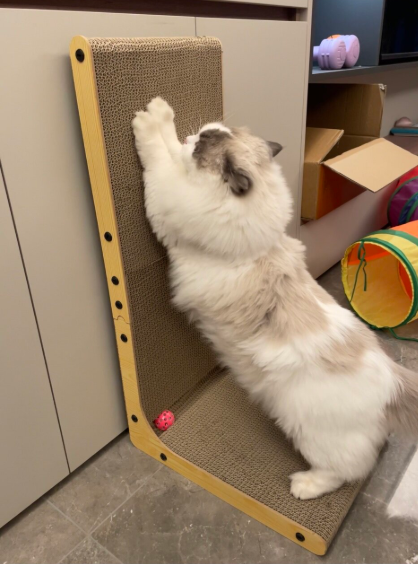
The reason scratching boards attract cats lies in their ability to satisfy both the instinctive behavioral and physiological needs of felines. Scratching is innate to cats; it serves purposes such as shedding old claw sheaths, marking territory, and relieving stress.
Scratching board designs are rooted in these behavioral patterns, utilizing specific materials, structures, and shapes to encourage cats to engage in this natural activity. Therefore, the key to understanding scratching boards is not to view them merely as consumer products, but to recognize how they resonate with a cat’s instincts.
Why corrugated cardboard works
Regarding material properties, corrugated cardboard is the most common choice. Its fibrous structure offers a balance of toughness and moderate resistance; as a cat’s claws sink in and pull downward, the paper layers tear naturally—mimicking the sensation of shredding tree bark, much like a cat would in the wild.
Additionally, the multi-layered structure allows for sufficient claw penetration, enabling the cat to shed old keratin layers as the claws rake across the surface. The material’s hardness is carefully calibrated: it is neither so rigid that it risks injuring the cat’s claws, nor so soft that it fails to provide effective claw maintenance.
How structure supports natural scratching
In terms of structural design, circular scratching boards often feature a spiral or concentric-circle stacking pattern. The advantage of this shape is that it provides scratching surfaces from multiple angles. Cats can scratch from any position around the circle without needing to shift their bodies, mirroring the way they might scratch a tree trunk from various directions in nature.
Furthermore, the circular structure offers stability; the board is unlikely to tip over during vigorous scratching, ensuring a more consistent and uninterrupted experience. Some scratching boards also incorporate a lounging area—often a recessed center—catering to a cat’s preference for secure spaces.
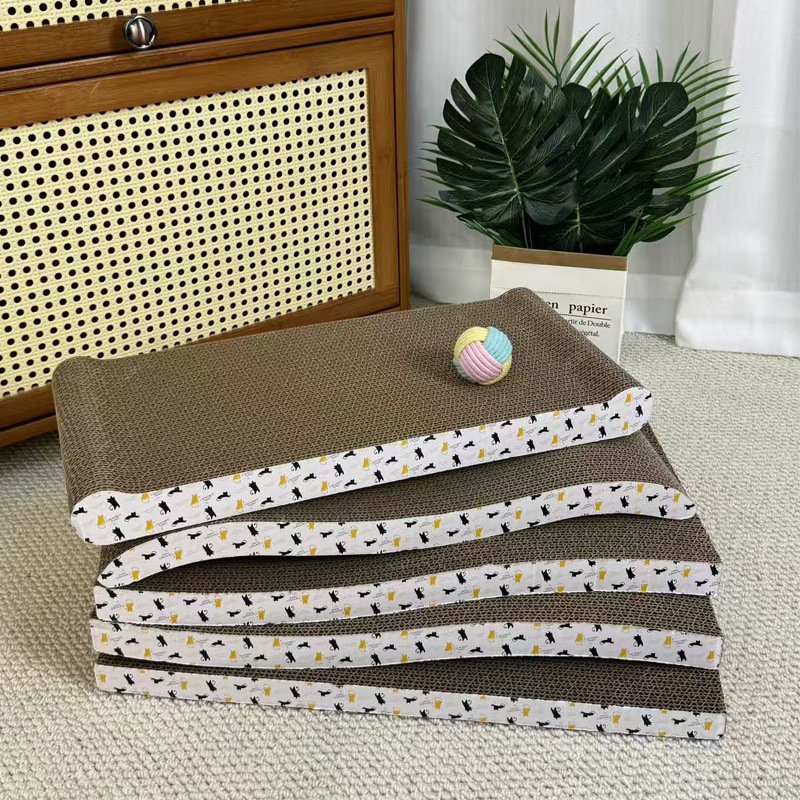
Shape, resistance and stability work together to support natural scratching and comfortable resting.
Scent, territory and placement
Cats tend to rest in familiar environments that carry their own scent; since scratching leaves behind scent markers, the board gradually becomes an integral part of the cat’s territory.
In practice, the appeal of a scratching board depends on its placement and the individual cat’s preferences. Cats typically prefer to scratch after waking up, after playing, or when feeling stressed; therefore, placing the board in areas where the cat is active—such as next to a sofa or near its bed—can increase usage rates.
Wear, replacement and continued interest
In multi-cat households, scratching boards can also serve as tools for scent exchange and social buffering, helping to reduce territorial conflicts.
It is worth noting that the rate at which a scratching board wears out is directly related to the frequency and intensity of the cat’s scratching; while high-density corrugated cardboard is more durable, it will eventually need to be replaced due to fiber breakage—a form of normal wear and tear.
It is generally acknowledged within the industry that regularly replacing scratching boards not only maintains the cat’s interest but also prevents them from turning to furniture when a board becomes excessively damaged.
Design rooted in feline behavior
Ultimately, the design of scratching boards is fundamentally an application of feline behavioral science; understanding this helps in making more informed choices regarding the selection and use of these products.